The Law of Attraction:
Science, Influence, & Cultural Myth
The Law of Attraction has resurfaced many times over the past century—sometimes embraced as a universal principle, other times dismissed as New Age snake oil or clever marketing.
This course takes a grounded, clear-eyed look at where these ideas came from, how they were shaped by culture, psychology, and early public relations, and why they continue to influence how people think about success, responsibility, and personal agency.
This is not a course about belief.
It is a course about understanding.
A Quiet Cultural Shift Few People Noticed
In the early 20th century, success was largely associated with craftsmanship, contribution, effort, and character. Over time—particularly after World War II—that definition began to change.
As mass media expanded and public relations matured, success increasingly became something that could be shaped, packaged, and communicated. Optimism, confidence, and belief were no longer just personal virtues; they became tools—used intentionally to influence perception, motivation, and behavior.
Around the 1950s, the American Dream subtly shifted. Achievement was no longer only about what you did, but about how effectively you projected certainty, positivity, and confidence—both to others and to yourself.
The Law of Attraction fit neatly into this evolving landscape. It offered a simplified narrative: that thoughts alone could determine outcomes, often without sufficient attention to context, structure, or responsibility.
This course explores that moment of convergence—where psychology, persuasion, and aspiration intersected—and how those ideas continue to shape modern thinking about success and personal agency.
Understanding this shift allows you to separate useful insight from oversimplified narratives.

Immediate Access
Memes and themes come and go.
I remember when essential oils were widely used in alternative health, then dismissed, only to re-emerge years later with stronger scientific support.
The Law of Attraction followed a similar pattern.
It gained widespread attention in 2006 with the movie The Secret, based on Napoleon Hill’s Think and Grow Rich.
After an intense period of promotion and reinterpretation, it faded—only to resurface again in recent years.
Judging by today’s media and messaging, it is clearly back.
The Law of Attraction: Science and Deceit?
Part 1
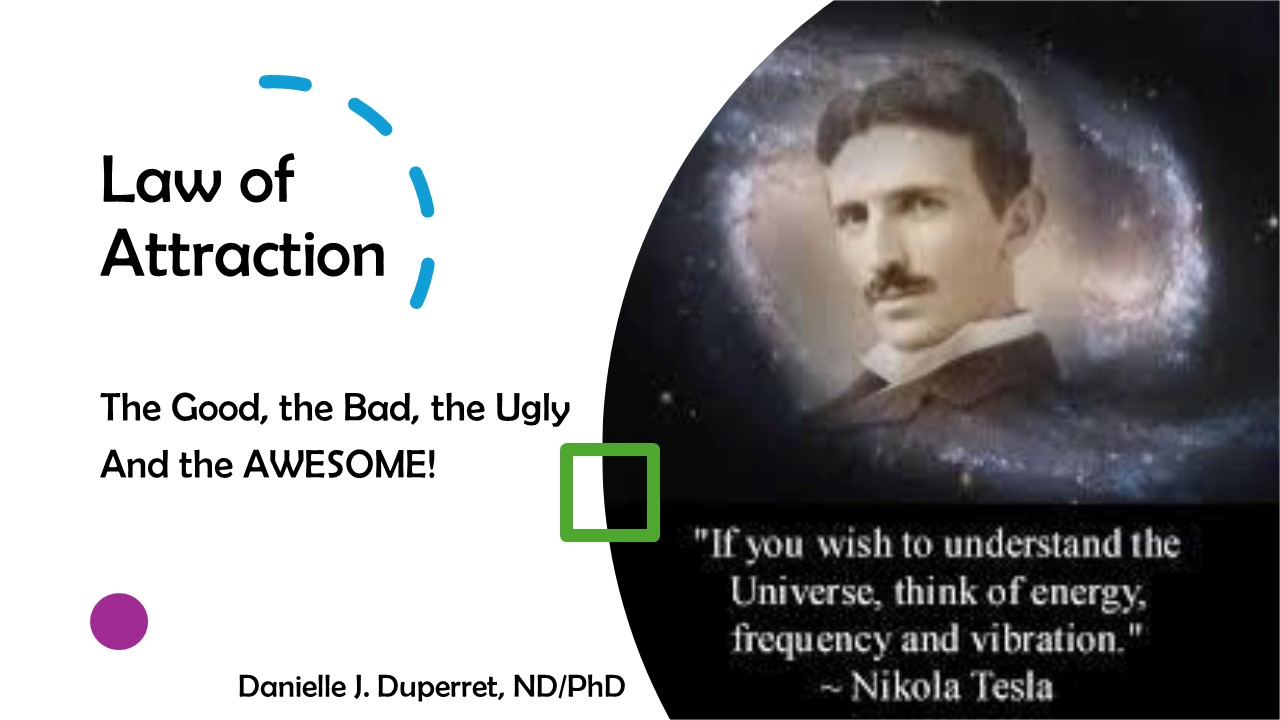
Energy, frequency, vibration—what do these terms actually mean?
We examine where these ideas come from and what science does (and does not) say about them.
Part 2
The Law of Attraction contains both insight and distortion.
Understanding the difference matters—especially when health, money, and responsibility are involved.
Part 3
A look at the research often cited in support of the Law of Attraction—and what it actually demonstrates about intention and outcomes.
Part 4
Energy is not just a metaphor.
From sound to chemistry to food, we explore how vibration is measured and interpreted—without mysticism..
Since completing my doctoral thesis on The Power of the Mind in Healing (1996), I’ve had the opportunity to observe both ends of the spectrum:
carefully controlled scientific research—and the more speculative New Age interpretations that have often led to confusion, shame, or false hope.
This course was created to help you form an informed, grounded understanding of the Law of Attraction—without hype or dismissal.
This Course May Be Right for You If…
You’re interested in understanding the Law of Attraction through history, psychology, and cultural context—and forming your own informed conclusions.
This Course Is Probably Not a Fit If…
You’re seeking affirmations, formulas, or promises of effortless results.
Science or Deceit?
You Decide.
I want to understand what’s real—and what isn’t.
Give me access to this course